
Les effets hypoalgiques immédiats de la mobilisation et de la manipulation chez des patients avec lombalgie chronique non spécifique
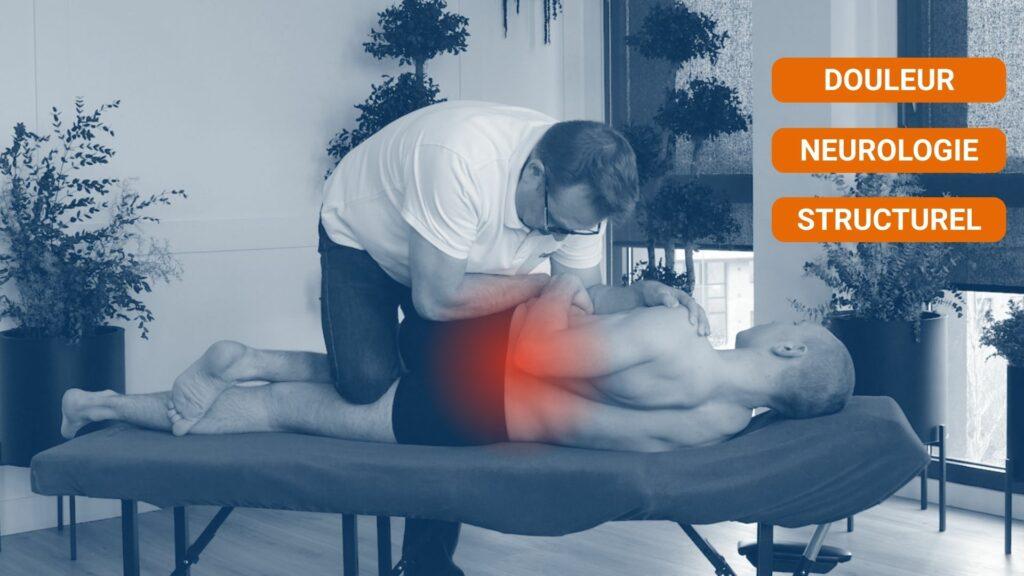
Cet essai contrôlé randomisé croisé a inclus 27 patients présentant une lombalgie chronique non spécifique (symptômes > 12 semaines, âge 18–60 ans). Les participants ont reçu, à une semaine d’intervalle, une séance de mobilisation lombaire (Grade IV type Maitland) ou de manipulation de type thrust en rotation, appliquées au segment le plus hypomobile identifié cliniquement.
Article
« The Immediate Hypoalgesic Effects of Mobilization and Manipulation in Patients with Non-Specific Chronic Low Back Pain: A Cross-Over Randomized Controlled Trial Thomas Sampsonis, Stefanos Karanasios * and George Gioftsos »
Résumé de l'étude
Les critères de jugement étaient :
- Seuils de douleur à la pression (PPT) au niveau lombaire, trapèze et tibial antérieur (local, régional, à distance), mesurés par algomètre digital.
- Douleur perçue (NPRS 0–10) sur la dernière semaine.healthcare-13-01719.pdf
- Amplitudes de mouvement (ROM) lombaires (flexion, extension, inclinaisons latérales) mesurées par inclinomètre électronique.
Il n’y a pas eu de différence significative entre la mobilisation et la manipulation pour aucun des critères (douleur, PPT, ROM). En revanche, à l’intérieur de chaque condition, on observe une réduction significative de la douleur (NPRS) et une augmentation des PPT (hypoalgésie) au niveau lombaire et des trapèzes, sans modification notable des amplitudes lombaires. Les auteurs concluent que mobilisation et manipulation ont des effets immédiats comparables sur la douleur chez des patients avec lombalgie chronique, et que le choix de la technique doit reposer sur le raisonnement clinique et la stratification individuelle du risque.
Chiffres clés
27 participants inclus, 0 perdu de vue.
Âge moyen : 38,4 ± 11,2 ans ; durée moyenne des symptômes : 56,1 ± 47,7 mois (≈ 4–5 ans).healthcare-13-01719.pdf
Douleur initiale (NPRS) ≈ 2,6/10, réduite d’environ 2 points immédiatement après chaque intervention, avec des tailles d’effet larges (Cohen d ≈ 0,97 pour la mobilisation, 1,1 pour la manipulation).
Aucune différence statistique entre mobilisation et manipulation sur :
- Seuils de douleur à la pression (L5, paravertébral L5, trapèze, tibial antérieur).
- Douleur NPRS post-intervention (différence inter‑techniques = 0,19 ; IC95 % −0,48 à 0,85 ; p = 0,58).
- ROM lombaire (flexion, extension, inclinaison latérale droite et gauche).
- Hypoalgésie significative dans chaque groupe (pré–post) sur les PPT lombaires paravertébraux et trapéziens (p entre 0,0001 et 0,018).
- Pas d’effet cliniquement important sur la mobilité lombaire immédiate (ROM, p non significatifs pour la plupart des mouvements).
- Aucun événement indésirable rapporté, interventions jugées sûres à court terme.
Ce que dit la littérature
- Les recommandations cliniques considèrent la thérapie manuelle (mobilisation, manipulation) comme une option de première intention dans la lombalgie chronique non spécifique, en complément de l’exercice, de l’éducation et d’une prise en charge multimodale.
- La littérature suggère des effets hypoalgiques de la manipulation sur les PPT locaux, régionaux et à distance, mais avec des résultats hétérogènes, souvent réalisés chez des sujets asymptomatiques ou avec des suivis très courts.
- Des revues systématiques et méta‑analyses récentes rapportent :
- Efficacité comparable de mobilisation et manipulation sur la douleur et la fonction dans la lombalgie chronique, avec parfois un avantage marginal pour la manipulation sur certains critères, mais pas de supériorité nette et constante.healthcare-13-01719.pdf
- Niveau de preuve limité concernant un effet immédiat robuste sur les PPT, en particulier en raison de l’hétérogénéité des populations (douleurs chroniques vs sujets sains) et des protocoles.
- Les mécanismes proposés combinent :
- Effets biomécaniques (modification de la mobilité segmentaire, charge tissulaire, circulation locale).
- Effets neurophysiologiques multi‑niveaux : modulation segmentaire médullaire, activation des voies descendantes inhibitrices (PAG, RVM), et ajustements supraspinaux des circuits de la douleur.
- Facteurs contextuels (placebo/nocebo, attentes, alliance thérapeutique), difficiles à isoler en l’absence de groupe placebo.
Ce qu’il faut retenir
- Mobilisation et manipulation lombaires produisent, chez des patients présentant une lombalgie chronique non spécifique, un soulagement immédiat de la douleur d’ampleur similaire, sans différence significative entre les deux techniques.
- Les effets bénéfiques immédiats portent surtout sur la perception douloureuse (NPRS, PPT) et très peu sur la mobilité globale lombaire.
- L’effet analgésique est probablement lié à une combinaison de mécanismes neurophysiologiques et contextuels, et non à un simple « recentrage » mécanique segmentaire.
- En l’absence de supériorité démontrée, le choix entre mobilisation et manipulation doit se fonder sur :
- Profil de risque (contre‑indications, drapeaux rouges, comorbidités).
- Préférences, croyances et appréhension du patient.
- Compétences et formation du praticien, et intégration dans un programme multimodal (exercice, éducation, auto‑prise en charge).
- Les résultats sont strictement à court terme ; aucune conclusion ne peut être tirée sur le maintien de l’effet à moyen ou long terme.
Mise en pratique pour un clinicien
- Lombalgie chronique non spécifique, sans radiculalgie ni drapeaux rouges (fracture, tumeur, infection, spondylolisthésis symptomatique, etc.).
- Évaluer soigneusement les contre‑indications à la manipulation (ostéoporose, antécédents chirurgicaux, pathologies structurales majeures).
- En présence de facteurs de risque, de crainte importante ou de préférence pour une approche « douce », privilégier la mobilisation segmentaire (grades élevés type Maitland).
- Chez un patient informé, sans contre‑indication, ouvert à la manipulation et présentant une hypomobilité segmentaire nette, la manipulation peut être envisagée sans prétention de supériorité, mais comme option équivalente.
- Utiliser une mobilisation ou une manipulation ciblée comme outil pour diminuer la douleur et améliorer le confort immédiat.
- Enchaîner systématiquement sur un travail actif :
- Exercices de contrôle moteur lombopelvien.
- Renforcement progressif.
- Exposition graduée au mouvement et aux activités fonctionnelles.
- Ancrer un discours éducatif : la douleur chronique est multifactorielle, le geste manuel est un outil parmi d’autres, pas un « réalignement » définitif.
- Mesurer la douleur (NPRS) avant/après séance, et, si possible, utiliser des tests simples de sensibilité mécanique (palpation standardisée, algométrie si disponible).
- Noter la réponse immédiate pour ajuster le dosage (grade, amplitude, nombre de répétitions) et la stratégie globale.
CONCLUSION
Cet essai randomisé croisé montre que, chez des adultes avec lombalgie chronique non spécifique, mobilisation et manipulation lombaires produisent des effets hypoalgiques immédiats comparables, sans différence significative sur la douleur, les seuils de douleur à la pression ou la mobilité de la colonne lombaire. La thérapie manuelle doit donc être envisagée comme un outil modulable, sécurisé et intégré dans une prise en charge globale centrée sur l’exercice, l’éducation et l’auto‑gestion, plutôt que comme une technique isolée supposée supérieure. Pour la pratique quotidienne, cela renforce l’idée que le choix de la technique relève du raisonnement clinique, des préférences du patient et de la balance bénéfice/risque, plus que d’une hiérarchie d’efficacité entre mobilisation et manipulation.
Bibliographie
- Hoy, D.; Bain, C.; Williams, G.; March, L.; Brooks, P.; Blyth, F.; Woolf, A.; Vos, T.; Buchbinder, R. A systematic review of the global prevalence of low back pain. Arthritis Rheum. 2012, 64, 2028–2037. [Google Scholar] [CrossRef] [PubMed]
- Sanchis-Sánchez, E.; Lluch-Girbés, E.; Guillart-Castells, P.; Georgieva, S.; García-Molina, P.; Blasco, J.M. Effectiveness of mechanical diagnosis and therapy in patients with non-specific chronic low back pain: A literature review with meta-analysis. Braz. J. Phys. Ther. 2021, 25, 117–134. [Google Scholar] [CrossRef] [PubMed]
- Dal Farra, F.; Risio, R.G.; Vismara, L.; Bergna, A. Effectiveness of osteopathic interventions in chronic non-specific low back pain: A systematic review and meta-analysis. Complement. Ther. Med. 2021, 56, 102616. [Google Scholar] [CrossRef] [PubMed]
- Oliveira, C.B.; Maher, C.G.; Pinto, R.Z.; Traeger, A.C.; Lin, C.W.C.; Chenot, J.F.; Van Tulder, M.; Koes, B.W. Clinical practice guidelines for the management of non-specific low back pain in primary care: An updated overview. Eur. Spine J. 2018, 27, 2791–2803. [Google Scholar] [CrossRef] [PubMed]
- George, S.Z.; Fritz, J.M.; Silfies, S.P.; Schneider, M.J.; Beneciuk, J.M.; Lentz, T.A.; Gilliam, J.R.; Hendren, S.; Norman, K.S.; Beattie, P.F.; et al. Interventions for the Management of Acute and Chronic Low Back Pain: Revision 2021: Clinical Practice Guidelines Linked to the International Classification of Functioning, Disability and Health from the Academy of Orthopaedic Physical Therapy of the American Physical Therapy Association. J. Orthop. Sports Phys. Ther. 2021, 51, CPG1–60. [Google Scholar] [PubMed]
- Cleland, J.A.; Flynn, T.W.; Childs, J.D.; Eberhart, S. The Audible Pop from Thoracic Spine Thrust Manipulation and Its Relation to Short-Term Outcomes in Patients with Neck Pain. J. Man. Manip. Ther. 2007, 15, 143–154. [Google Scholar] [CrossRef] [PubMed][Green Version]
- Bialosky, J.E.; Bishop, M.D.; Price, D.D.; Robinson, M.E.; George, S.Z. The mechanisms of manual therapy in the treatment of musculoskeletal pain: A comprehensive model. Man. Ther. 2009, 14, 531–538. [Google Scholar] [CrossRef] [PubMed]
- Fryer, G. Integrating osteopathic approaches based on biopsychosocial therapeutic mechanisms. Part 1: The mechanisms. Int. J. Osteopath. Med. 2017, 25, 30–41. [Google Scholar] [CrossRef]
- Bialosky, J.E.; George, S.Z.; Horn, M.E.; Price, D.D.; Staud, R.; Robinson, M.E. Spinal Manipulative Therapy–Specific Changes in Pain Sensitivity in Individuals with Low Back Pain (NCT01168999). J. Pain 2014, 15, 136–148. [Google Scholar] [CrossRef] [PubMed]
- Coronado, R.A.; Gay, C.W.; Bialosky, J.E.; Carnaby, G.D.; Bishop, M.D.; George, S.Z. Changes in pain sensitivity following spinal manipulation: A systematic review and meta-analysis. J. Electromyogr. Kinesiol.2012, 22, 752–767. [Google Scholar] [CrossRef] [PubMed]
- Dorron, S.L.; Losco, B.E.; Drummond, P.D.; Walker, B.F. Effect of lumbar spinal manipulation on local and remote pressure pain threshold and pinprick sensitivity in asymptomatic individuals: A randomised trial. Chiropr. Man. Ther. 2016, 24, 47. [Google Scholar] [CrossRef] [PubMed]
- de Oliveira, R.F.; Liebano, R.E.; Costa Lda, C.M.; Rissato, L.L.; Costa, L.O.P. Immediate Effects of Region-Specific and Non–Region-Specific Spinal Manipulative Therapy in Patients with Chronic Low Back Pain: A Randomized Controlled Trial. Phys. Ther. 2013, 93, 748–756. [Google Scholar] [CrossRef] [PubMed]
- Thomson, O.; Haig, L.; Mansfield, H. The effects of high-velocity low-amplitude thrust manipulation and mobilisation techniques on pressure pain threshold in the lumbar spine. Int. J. Osteopath. Med. 2009, 12, 56–62. [Google Scholar] [CrossRef]
- Yu, X.; Wang, X.; Zhang, J.; Wang, Y. Changes in Pressure Pain Thresholds and Basal Electromyographic Activity After Instrument-Assisted Spinal Manipulative Therapy in Asymptomatic Participants: A Randomized, Controlled Trial. J. Manip. Physiol. Ther. 2012, 35, 437–445. [Google Scholar] [CrossRef] [PubMed]
- Coulter, I.D.; Crawford, C.; Hurwitz, E.L.; Vernon, H.; Khorsan, R.; Suttorp Booth, M.; Herman, P.M. Manipulation and mobilization for treating chronic low back pain: A systematic review and meta-analysis. Spine J. 2018, 18, 866–879. [Google Scholar] [CrossRef] [PubMed]
- Rubinstein, S.M.; de Zoete, A.; van Middelkoop, M.; Assendelft, W.J.J.; de Boer, M.R.; van Tulder, M.W. Benefits and harms of spinal manipulative therapy for the treatment of chronic low back pain: Systematic review and meta-analysis of randomised controlled trials. BMJ 2019, 13, l689. [Google Scholar] [CrossRef] [PubMed]
- Maher, C.; Underwood, M.; Buchbinder, R. Non-specific low back pain. Lancet 2017, 389, 736–747. [Google Scholar] [CrossRef] [PubMed]
- WHO. WHO Guidelines on Basic Training and Safety in Chiropractic; World Health Organization: Geneva, Switzerland, 2005; 44p. [Google Scholar]
- Airaksinen, O.; Brox, J.I.; Cedraschi, C.; Hildebrandt, J.; Klaber-Moffett, J.; Kovacs, F.; Mannion, A.F.; Reis, S.; Staal, J.B.; Ursin, H.; et al. Chapter 4 European guidelines for the management of chronic nonspecific low back pain. Eur. Spine J. 2006, 15, s192–s300. [Google Scholar] [CrossRef] [PubMed]
- Koes, B.W.; van Tulder, M.W.; Thomas, S. Diagnosis and treatment of low back pain. BMJ 2006, 332, 1430–1434. [Google Scholar] [CrossRef] [PubMed]
- Childs, J.D.; Fritz, J.M.; Flynn, T.W.; Irrgang, J.J.; Johnson, K.K.; Majkowski, G.R. A Clinical Prediction Rule to Identify Patients with Low Back Pain Most Likely to Benefit from Spinal Manipulation: A Validation Study. Ann. Intern. Med. 2004, 141, 920. [Google Scholar] [CrossRef] [PubMed]
- Spring, F.; Gibbons, P.; Tehan, P. Intra-examiner and inter-examiner reliability of a positional diagnostic screen for the lumbar spine. J. Osteopath. Med. 2001, 4, 47–55. [Google Scholar] [CrossRef]
- van Trijffel, E.; Anderegg, Q.; Bossuyt, P.M.M.; Lucas, C. Inter-examiner reliability of passive assessment of intervertebral motion in the cervical and lumbar spine: A systematic review. Man. Ther. 2005, 10, 256–269. [Google Scholar] [CrossRef] [PubMed]
- Nim, C.G.; Downie, A.; O’Neill, S.; Kawchuk, G.N.; Perle, S.M.; Leboeuf-Yde, C. The importance of selecting the correct site to apply spinal manipulation when treating spinal pain: Myth or reality? A systematic review. Sci. Rep. 2021, 11, 23415. [Google Scholar] [CrossRef] [PubMed]
- Wong, A.Y.L.; Parent, E.C.; Dhillon, S.S.; Prasad, N.; Kawchuk, G.N. Do Participants with Low Back Pain Who Respond to Spinal Manipulative Therapy Differ Biomechanically from Nonresponders, Untreated Controls or Asymptomatic Controls? Spine 2015, 40, 1329–1337. [Google Scholar] [CrossRef] [PubMed]
- Colloca, C.J.; Keller, T.S.; Gunzburg, R. Biomechanical and neurophysiological responses to spinal manipulation in patients with lumbar radiculopathy. J. Manip. Physiol. Ther. 2004, 27, 1–15. [Google Scholar] [CrossRef] [PubMed]
- Lystad, R.P.; Bell, G.; Bonnevie-Svendsen, M.; Carter, C.V. Manual therapy with and without vestibular rehabilitation for cervicogenic dizziness: A systematic review. Chiropract. Man. Ther. 2011, 19, 21. [Google Scholar] [CrossRef] [PubMed]
- Currie, S.J.; Myers, C.A.; Enebo, B.A.; Davidson, B.S. Treatment and Response Factors in Muscle Activation during Spinal Manipulation. J. Clin. Med. 2023, 12, 6377. [Google Scholar] [CrossRef] [PubMed]
- Corrêa, J.B.; Costa, L.O.P.; de Oliveira, N.T.B.; Sluka, K.A.; Liebano, R.E. Central sensitization and changes in conditioned pain modulation in people with chronic nonspecific low back pain: A case–control study. Exp. Brain Res. 2015, 233, 2391–2399. [Google Scholar] [CrossRef] [PubMed]
- Dias, L.V.; Cordeiro, M.A.; Schmidt de Sales, R.; dos Santos, M.M.B.R.; Korelo, R.I.G.; Vojciechowski, A.S. Immediate analgesic effect of transcutaneous electrical nerve stimulation (TENS) and interferential current (IFC) on chronic low back pain: Randomised placebo-controlled trial. J. Bodyw. Mov. Ther. 2021, 27, 181–190. [Google Scholar] [CrossRef] [PubMed]
- Neziri, A.Y.; Curatolo, M.; Limacher, A.; Nüesch, E.; Radanov, B.; Andersen, O.K.; Arendt-Nielsen, L.; Jüni, P. Ranking of parameters of pain hypersensitivity according to their discriminative ability in chronic low back pain. Pain 2012, 153, 2083–2091. [Google Scholar] [CrossRef] [PubMed]
- O’Neill, S.; Kjær, P.; Graven-Nielsen, T.; Manniche, C.; Arendt-Nielsen, L. Low pressure pain thresholds are associated with, but does not predispose for, low back pain. Eur. Spine J. 2011, 20, 2120–2125. [Google Scholar] [CrossRef] [PubMed]
- Corrêa, J.B.; Costa, L.O.P.; Oliveira, N.T.B.; Lima, W.P.; Sluka, K.A.; Liebano, R.E. Effects of the carrier frequency of interferential current on pain modulation and central hypersensitivity in people with chronic nonspecific low back pain: A randomized placebo-controlled trial. Eur. J. Pain 2016, 20, 1653–1666. [Google Scholar] [CrossRef] [PubMed]
- Mailloux, C.; Beaulieu, L.D.; Wideman, T.H.; Massé-Alarie, H. Within-session test-retest reliability of pressure pain threshold and mechanical temporal summation in healthy subjects. Rushton A, editor. PLoS ONE 2021, 16, e0245278. [Google Scholar] [CrossRef] [PubMed]
- Childs, J.D.; Piva, S.R.; Fritz, J.M. Responsiveness of the Numeric Pain Rating Scale in Patients with Low Back Pain. Spine 2005, 30, 1331–1334. [Google Scholar] [CrossRef] [PubMed]
- Jensen, M.P.; Turner, J.A.; Romano, J.M.; Fisher, L.D. Comparative reliability and validity of chronic pain intensity measures. Pain 1999, 83, 157–162. [Google Scholar] [CrossRef] [PubMed]
- Sly, E.; Coleman, C.; Quinn, D.; Armstrong, S.M.; Garvey, C.; O’Donoghue, C.; Wilson, F. The effect of two exercise protocols on lumbar spine sagittal range of motion. J. Back. Musculoskelet. Rehabil. 2014, 27, 445–452. [Google Scholar] [CrossRef] [PubMed]
- Nascimento, J.D.S.D.; Alburquerque-Sendín, F.; Vigolvino, L.P.; Oliveira, W.F.D.; Sousa, C.D.O. Absolute and Relative Reliability of Pressure Pain Threshold Assessments in the Shoulder Muscles of Participants with and Without Unilateral Subacromial Impingement Syndrome. J. Manip. Physiol. Ther. 2020, 43, 57–67. [Google Scholar] [CrossRef] [PubMed]
- Fagundes Loss, J.; de Souza da Silva, L.; Ferreira Miranda, I.; Groisman, S.; Santiago Wagner Neto, E.; Souza, C.; Tarragô Candotti, C. Immediate effects of a lumbar spine manipulation on pain sensitivity and postural control in individuals with nonspecific low back pain: A randomized controlled trial. Chiropract. Man. Ther. 2020, 28, 25. [Google Scholar] [CrossRef] [PubMed]
- Almeida, V.C.; Pereira, L.C.D.; Waqqar, S.; Flores, A.E.; Silva Junior, W.M.D.; Maciel, L.Y.D.S.; de Farias Neto, J.P.; Zacca, R.; de Santana Filho, V.J. Pressure Pain Threshold Protocols with Pressure Algometer in Patients with Low Back Pain: A Systematic Review with Meta-Analysis. J. Manip. Physiol. Ther. 2023, 46, 327–345. [Google Scholar] [CrossRef] [PubMed]
- Koh, R.G.; Paul, T.M.; Nesovic, K.; West, D.; Kumbhare, D.; Wilson, R.D. Reliability and minimal detectable difference of pressure pain thresholds in a pain-free population. Br. J. Pain 2023, 17, 239–243. [Google Scholar] [CrossRef] [PubMed]
- Walton, D.; MacDermid, J.; Nielson, W.; Teasell, R.; Chiasson, M.; Brown, L. Reliability, Standard Error, and Minimum Detectable Change of Clinical Pressure Pain Threshold Testing in People with and Without Acute Neck Pain. J. Orthop. Sports Phys. Ther. 2011, 41, 644–650. [Google Scholar] [CrossRef] [PubMed]
- Fryer, G.; Carub, J.; McIver, S. The effect of manipulation and mobilisation on pressure pain thresholds in the thoracic spine. J. Osteopath. Med. 2004, 7, 8–14. [Google Scholar] [CrossRef]
- Valera-Calero, A.; Lluch Girbés, E.; Gallego-Izquierdo, T.; Malfliet, A.; Pecos-Martín, D. Endocrine response after cervical manipulation and mobilization in people with chronic mechanical neck pain: A randomized controlled trial. Eur. J. Phys. Rehabil. Med. 2019, 55, 792–805. [Google Scholar] [CrossRef] [PubMed]
- Jung, A.; Adamczyk, W.M.; Ahmed, A.; Van Der Schalk, L.; Poesl, M.; Luedtke, K.; Szikszay, T.M. No Sufficient Evidence for an Immediate Hypoalgesic Effect of Spinal Manual Therapy on Pressure Pain Thresholds in Asymptomatic and Chronic Pain Populations: A Systematic Review and Meta-Analysis. Phys. Ther. 2023, 103, pzad003. [Google Scholar] [CrossRef] [PubMed]
- Thomas, J.S.; Clark, B.C.; Russ, D.W.; France, C.R.; Ploutz-Snyder, R.; Corcos, D.M.; RELIEF Study Investigators. Effect of Spinal Manipulative and Mobilization Therapies in Young Adults with Mild to Moderate Chronic Low Back Pain: A Randomized Clinical Trial. JAMA Netw. Open 2020, 3, e2012589. [Google Scholar] [CrossRef] [PubMed]
- Randoll, C.; Gagnon-Normandin, V.; Tessier, J.; Bois, S.; Rustamov, N.; O’Shaughnessy, J.; Descarreaux, M.; Piché, M. The mechanism of back pain relief by spinal manipulation relies on decreased temporal summation of pain. Neuroscience 2017, 349, 220–228. [Google Scholar] [CrossRef] [PubMed]
- Rossettini, G.; Carlino, E.; Testa, M. Clinical relevance of contextual factors as triggers of placebo and nocebo effects in musculoskeletal pain. BMC Musculoskelet. Disord. 2018, 19, 27. [Google Scholar] [CrossRef] [PubMed]
- Setchell, J.; Costa, N.; Ferreira, M.; Hodges, P.W. What decreases low back pain? A qualitative study of patient perspectives. Scand. J. Pain 2019, 19, 597–603. [Google Scholar] [CrossRef] [PubMed]
- Ferreira, M.L.; Herbert, R.D.; Ferreira, P.H.; Latimer, J.; Ostelo, R.W.; Grotle, M.; Barett, B. The smallest worthwhile effect of nonsteroidal anti-inflammatory drugs and physiotherapy for chronic low back pain: A benefit–harm trade-off study. J. Clin. Epidemiol. 2013, 66, 1397–1404. [Google Scholar] [CrossRef] [PubMed]